
Crypto Market Weekly
Risk Assets Are Getting Risky Again

Hey everyone, and welcome to the Weekly Market Roundup #29.
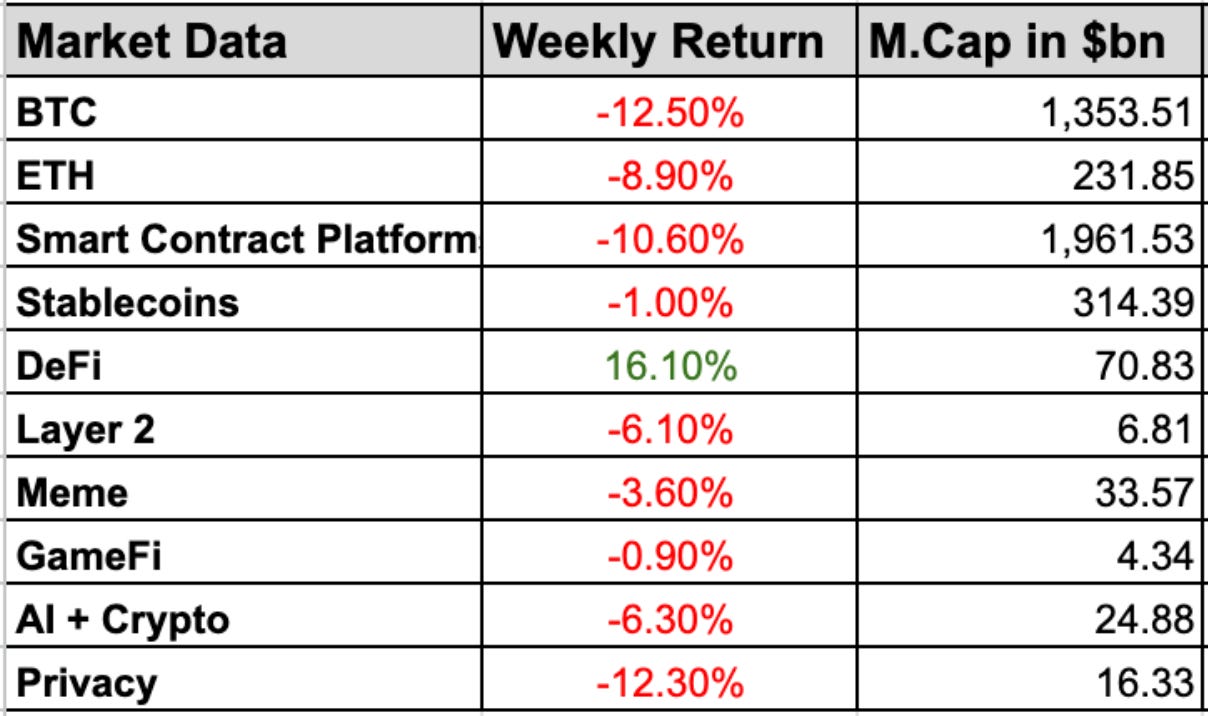
Bitcoin slipped to fresh two-month lows this week, trading below $70,000 for the first time since early April as sellers stayed firmly in control. BTC printed an intraday low near $67,000 after fading from a high around $72,800, leaving it roughly 44% below the October 2025 all-time high near $126.2K. The standout theme was divergence: equities ripped while crypto discounted geopolitics, with the S&P 500 tagging a fresh record above 7,600 even as BTC stayed bearish on US–Iran headlines. Ceasefire hopes had faded into Monday before Trump signaled talks were “continuing at a rapid pace,” but crypto refused to price in the optimism.
Flows did the rest of the damage : spot Bitcoin ETFs logged a record 10-session, ~$2.97 billion outflow streak, the longest run of withdrawals on record, while May alone saw more than $2.3 billion pulled, the weakest month for institutional demand since late 2025. The leverage flush was brutal: over 152,000 traders were liquidated in 24 hours with total liquidations near $744 million, confirming the move was driven as much by forced deleveraging as spot selling, and Mt. Gox-linked wallets moving 10,306 BTC (~$739 million) added a fresh supply scare.
Technically, attention has now shifted to the long-term trend lines as bulls failed to mount a rescue. The $72,500–$73,000 zone has flipped from support to resistance, and the structural read stays bearish until $73,000 is reclaimed on a closing basis; below current price, $67,000 is the next key support with $65,000 in focus if pressure persists. Price also sits well under Strategy’s ~$76,020 average cost basis, leaving that position underwater and removing a buyer that previously absorbed dips. The weakness wasn’t isolated to BTC, Ether drifted toward $2,000 after an early OG whale offloaded roughly $136 million in ETH, though on-chain data showed no broad capitulation among long-term holders, with $1,500 as the next major support if the level breaks.
One bright spot bucking the gloom: Hyperliquid overtook Ethereum as the second-largest chain by 30-day app revenue at $57.9M, and HYPE rallied ~25% after the CFTC formally recognized perpetuals as legitimate price-discovery and risk-management tools, a rare bullish fundamental in an otherwise risk-off tape.
In this issue, I’ll break down what actually drove the movement, how macro catalysts are compressing into a high-impact window, what on-chain flows are revealing about holder behaviour, and where structural momentum may emerge next.
Let’s get into it.
1. Sector Performance & Key Developments
Hyperliquid is beating ethereum in trading volume on some days as big money rotates, says FalconX
Movement pivots to stablecoin payments as the layer-2 boom loses momentum
Stellar CEO says Clarity Act would help, but tokenization isn’t dependent on it
Strive added 2,500 bitcoin last week to reach 19,000 BTC as Strategy sold
US seized $1 billion in Iranian crypto assets under ‘Operation Economic Fury’, says Bessent
Jamie Dimon slams Coinbase CEO as ‘full of sh*t’ and warns banks won’t accept crypto bill
Binance Ventures Into US Stocks Trading For Overseas Customers, Eyes Tokenized Shares In ‘Super App’ Push
Telegram rebrands TON coin to GRAM, announces Pavel Durov
2. The Most Underpriced Risk In Global Markets
For most of this year, markets have been trading a near-perfect outcome.
Growth slows, but not enough to trigger a recession. Inflation falls, but not enough to damage demand. The Fed cuts, earnings stay strong, and AI spending creates the next leg of economic expansion
It’s an attractive narrative.
The problem is that some of the underlying data is starting to tell a different story.
The latest GDP revision showed the U.S. economy was weaker than initially reported, while corporate profit growth slowed sharply from nearly $247 billion in Q4 to just $40 billion in Q1.
That’s not a recession signal. But it is a reminder that economic momentum was fading even before higher energy prices began filtering through the system.
The consumer isn’t sending reassuring signals either.
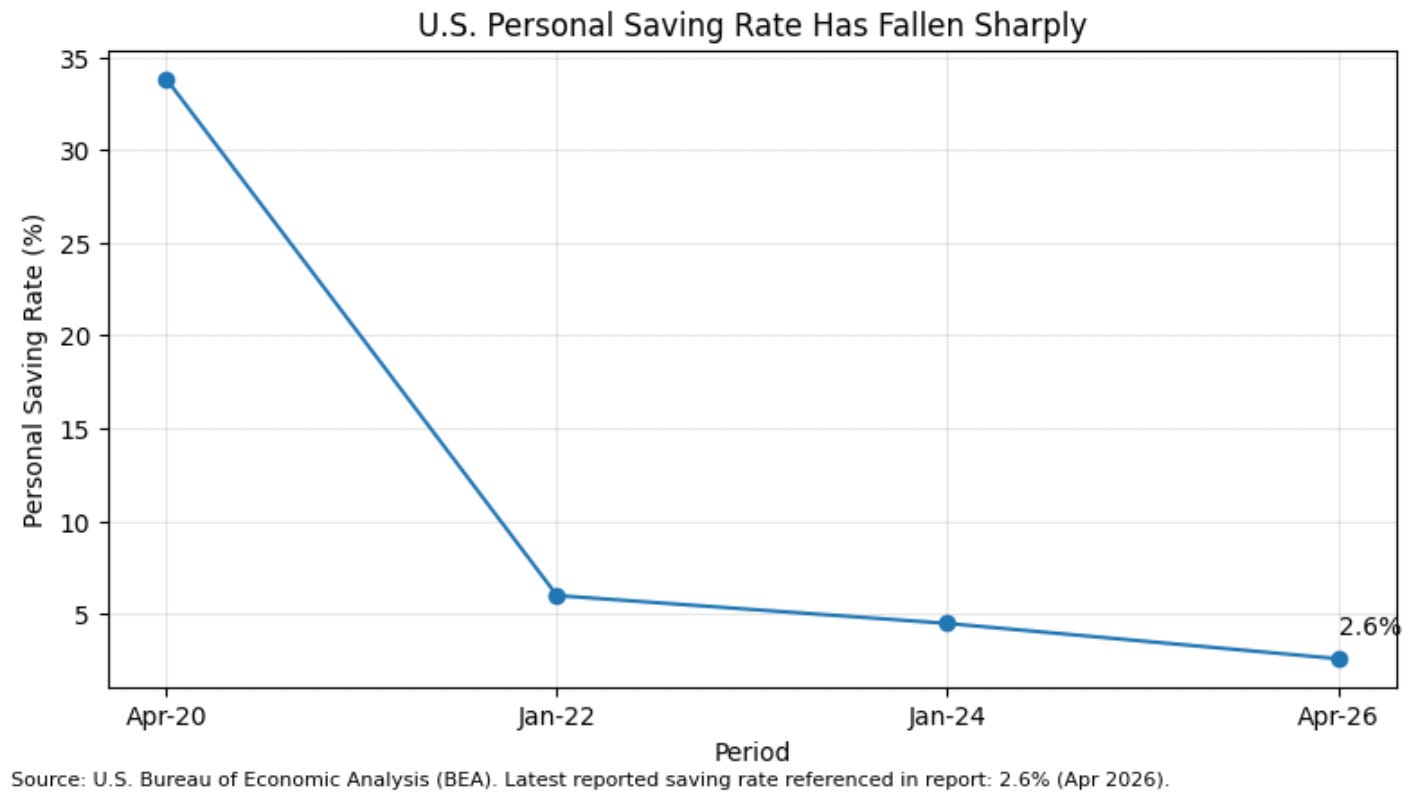
Disposable income declined in April, yet spending continued rising. Meanwhile, the savings rate has fallen to just 2.6%, one of the lowest levels of this cycle. Consumers are still spending, but increasingly from a position of necessity rather than strength.
That distinction matters.
Markets tend to focus on whether spending is happening. The more important question is how it’s happening.
At the same time, inflation expectations are beginning to move in the wrong direction. Long-term expectations climbed from 3.5% to 3.9%, while one-year expectations reached 4.8%. Those aren’t crisis numbers, but they are high enough to keep the Fed uncomfortable
And that’s where things get interesting.
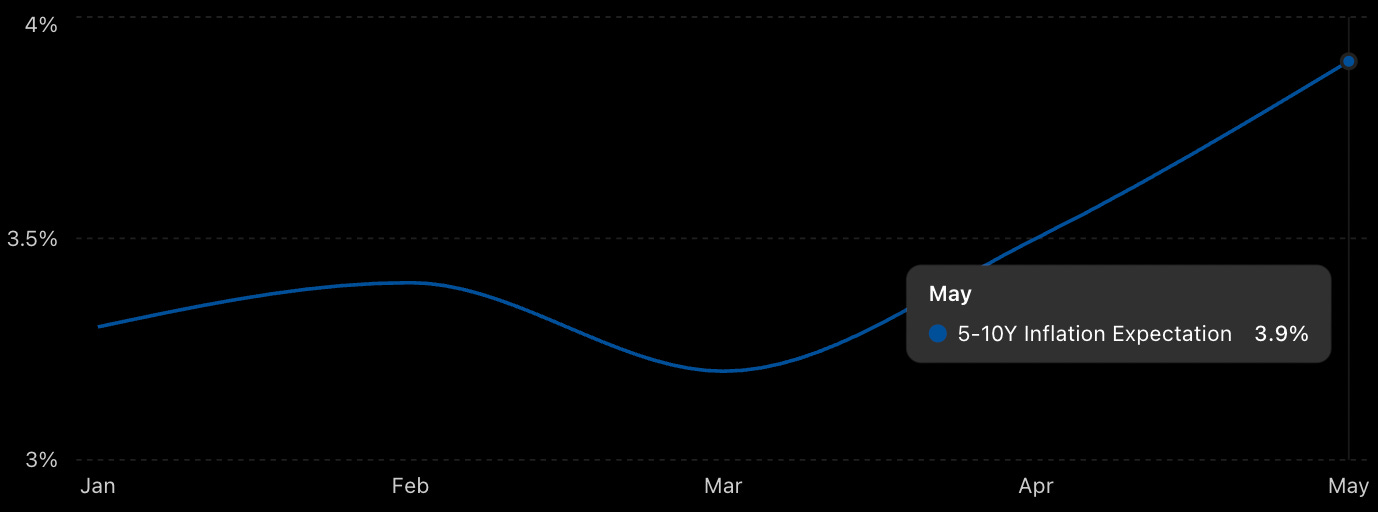
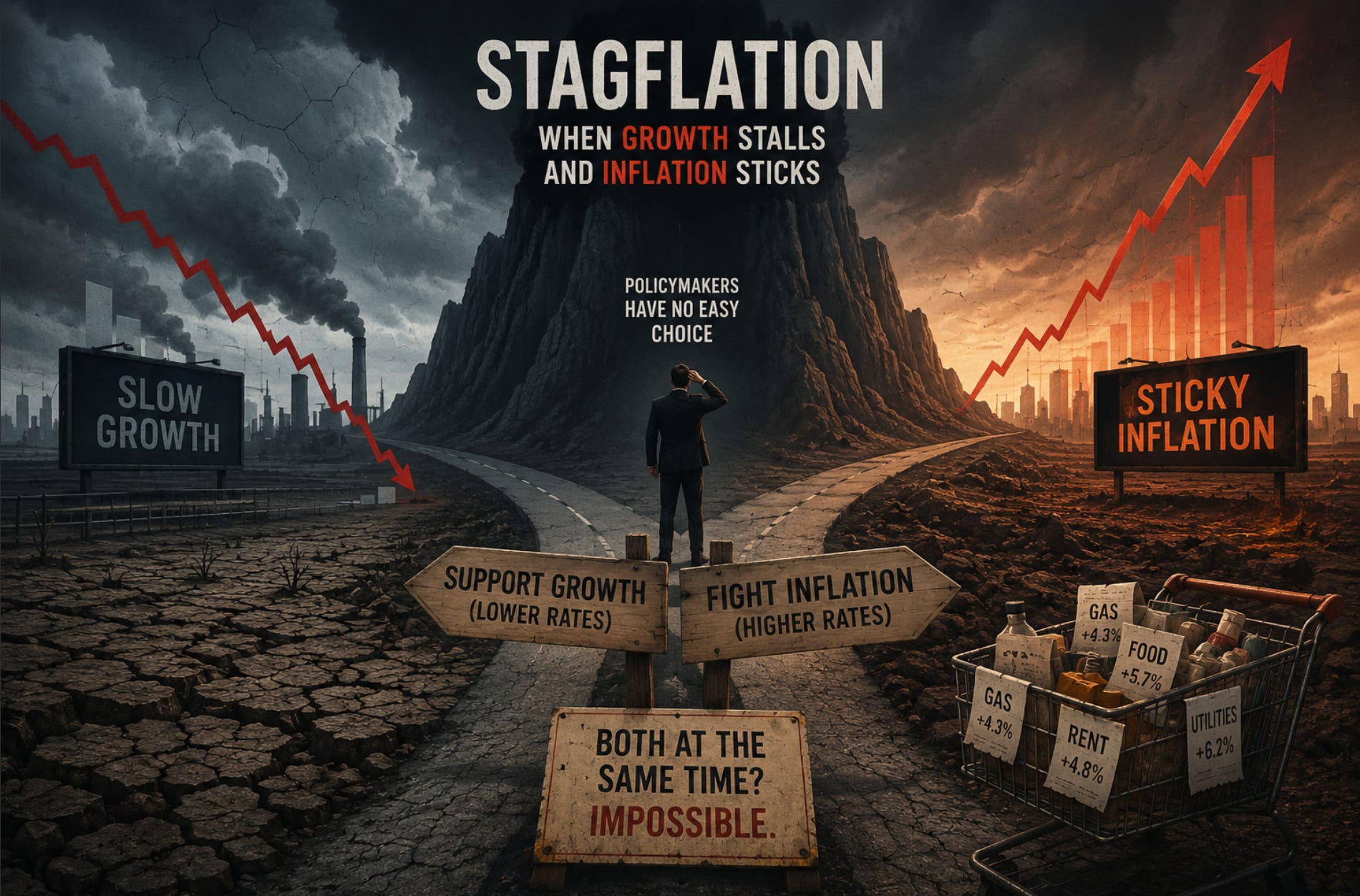
Investors remain focused on softer monthly inflation prints. The Fed is likely paying more attention to inflation expectations and energy-driven second-order effects. If expectations continue rising while growth continues slowing, policymakers find themselves trapped between supporting the economy and fighting inflation.
Historically, that’s where things start to break.
The market’s biggest assumption today is that AI-driven investment will offset any economic weakness. Goldman estimates AI-related spending could account for roughly 40% of S&P 500 earnings growth this year, while major cloud companies are expected to spend nearly $670 billion on infrastructure in 2026.
That’s an extraordinary bet.
Not because AI won’t work, but because it assumes consumers stay resilient, earnings remain strong, and inflation falls quickly enough for monetary policy to ease.
The market isn’t pricing disaster.
It’s pricing a very specific sequence of positive outcomes.
The real risk isn’t recession. The real risk is a world where growth keeps slowing, inflation stays stuck above target, and the Fed remains sidelined far longer than investors expect. That’s a much less comfortable environment for both equities and crypto than current valuations suggest.
3. Macro Backdrop
1. Manufacturing Is Finally Waking Up
One of the most overlooked developments in the U.S. economy right now is happening in manufacturing
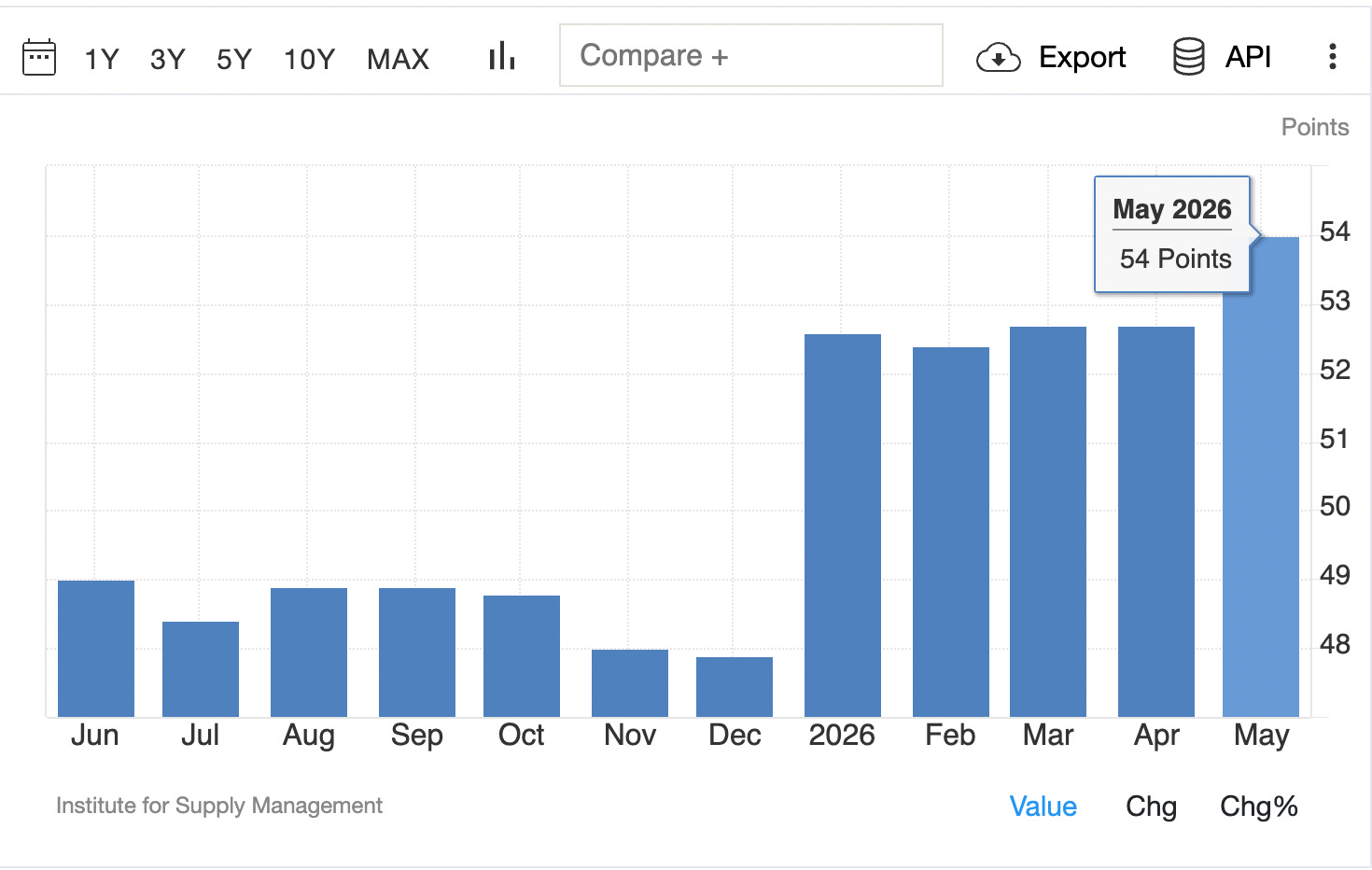
ISM Manufacturing PMI came in at 54.0, its highest reading since 2022 and above expectations of 53.3. More importantly, this wasn’t a one-month surprise.
January: 52.6
February: 52.4
March: 52.7
April: 52.7
May: 54.0
That’s five consecutive months of expansion after spending nearly two years stuck in contraction territory.
For most of 2023, 2024 and early 2025, higher rates effectively froze the manufacturing cycle. Today, that cycle appears to be turning.
What’s interesting is that manufacturing recoveries tend to benefit small and mid-sized businesses far more than the mega-cap AI names that have dominated markets over the last two years.
The market has been trading seven stocks. Manufacturing suggests the rest of the economy may finally be joining the party.
One historical relationship worth watching: crypto bull markets have often become far more aggressive once ISM moves above 56, reflecting stronger growth, improving liquidity, and rising risk appetite across markets. We’re not there yet.
But after two years of contraction, manufacturing is finally moving in the right direction.
2. Geopolitical Developments: Same Headlines, Same Deadlock
This weekend brought more noise than progress
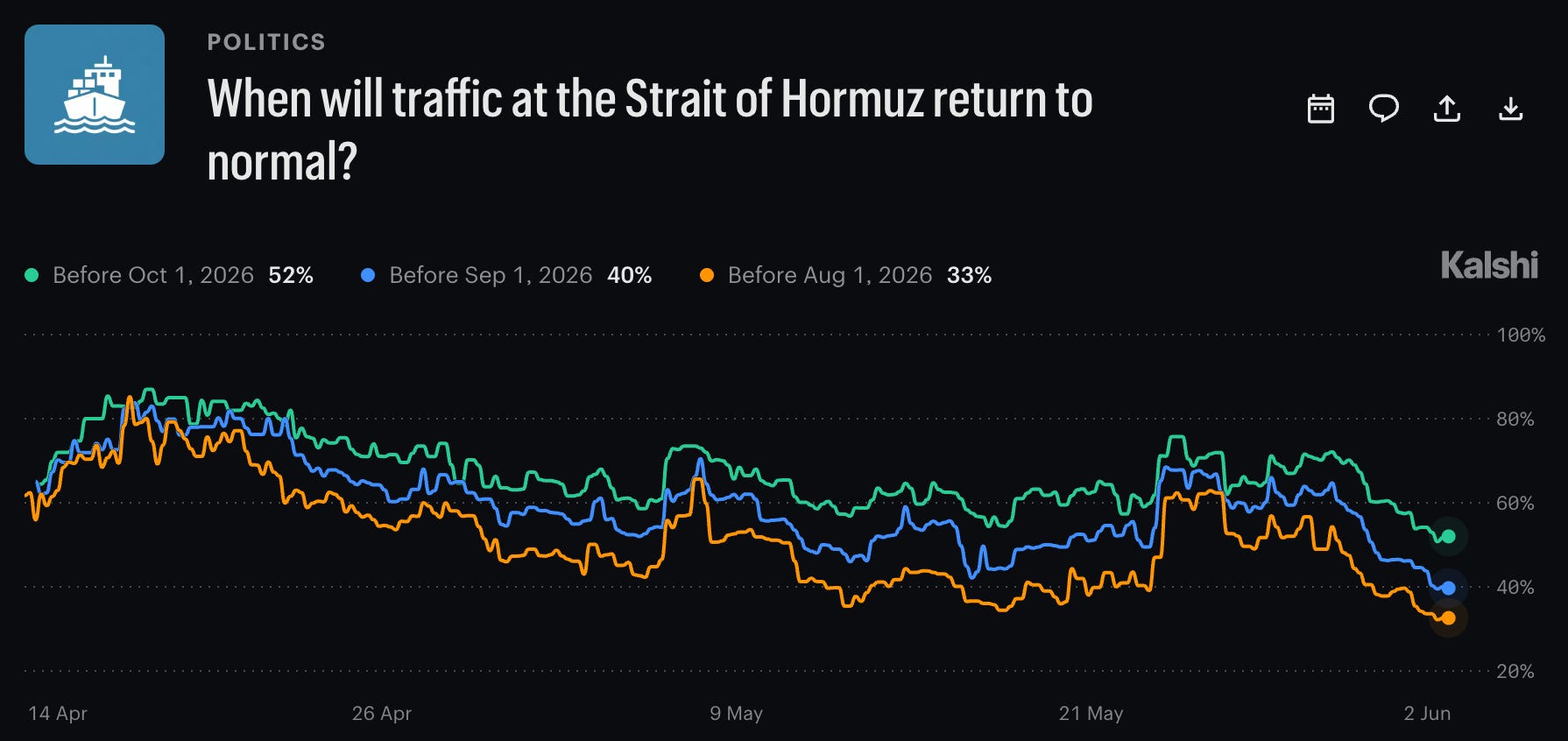
Just as a potential U.S.-Iran agreement appeared close, negotiations stalled again after the Trump administration toughened its stance, particularly around sanctions relief and nuclear commitments.
The core issue remains unchanged. The U.S. wants strict verification measures and limits on Iran’s enriched uranium stockpile, while Iran continues to reject any demands that would significantly restrict its nuclear program.
Another major sticking point remains the Strait of Hormuz. Iran wants greater control over shipping arrangements through the region, while the U.S. continues to insist on unrestricted navigation through one of the world’s most important energy corridors.
Adding to tensions, recent satellite imagery reportedly showed Iran rebuilding and expanding military infrastructure during ceasefire periods, reinforcing concerns that diplomatic pauses are being used to strengthen strategic positions.
On top of that, political pressure is rising on both sides. Hardliners in Iran are opposing concessions, while hawkish factions in Washington continue pushing for tougher conditions.
For markets, this means geopolitical risk remains elevated and energy markets are likely to stay sensitive to any developments coming out of the region.
3. Global Monetary Shifts Are Accelerating
Three developments this week point to the same underlying theme: the global monetary order is becoming increasingly fragmented.
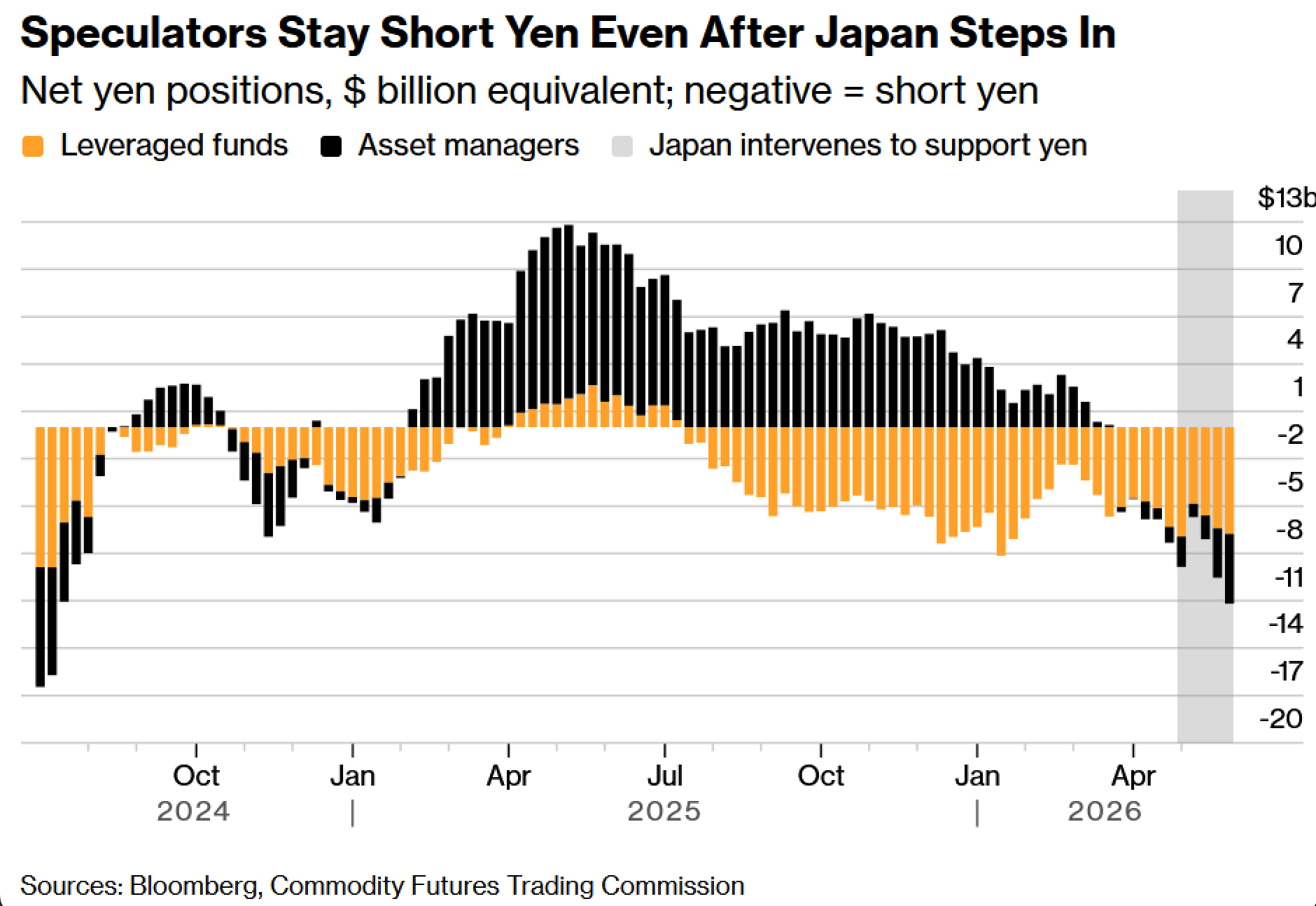
In Japan, policymakers are rapidly running out of options. Despite deploying a record $73.6 billion in FX intervention last month, the yen still underperformed every other G10 currency. Even more telling, speculative traders increased their bearish bets despite the intervention
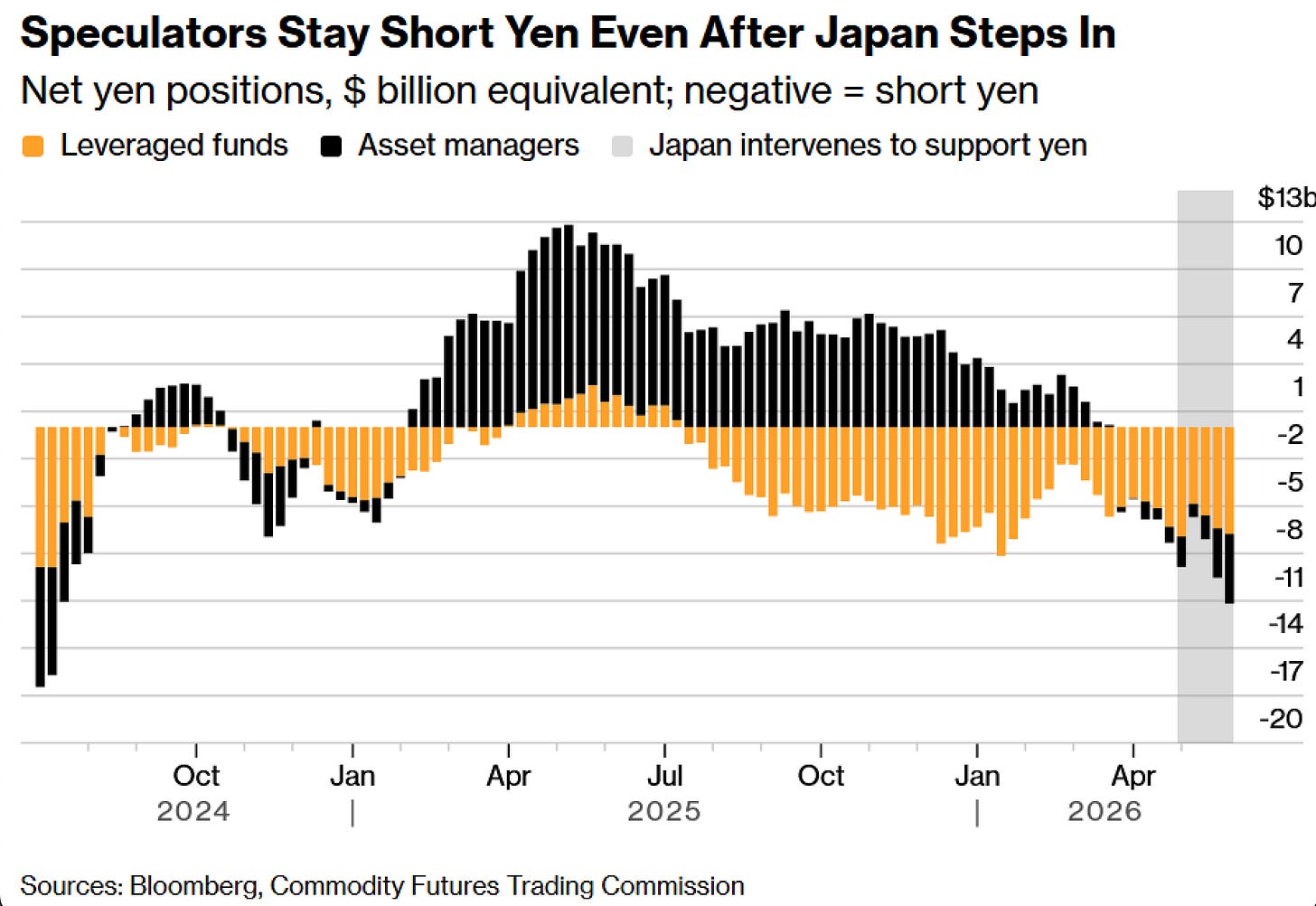
The market understands the problem. Currency interventions can slow moves temporarily, but they cannot overcome a massive interest rate differential. With U.S. rates still far above Japanese rates, the pressure on the yen remains intact. All eyes now turn to the Bank of Japan’s June meeting, where markets see a rate hike as the last credible tool available.
Meanwhile, central banks continue sending a powerful message through their reserve allocations.
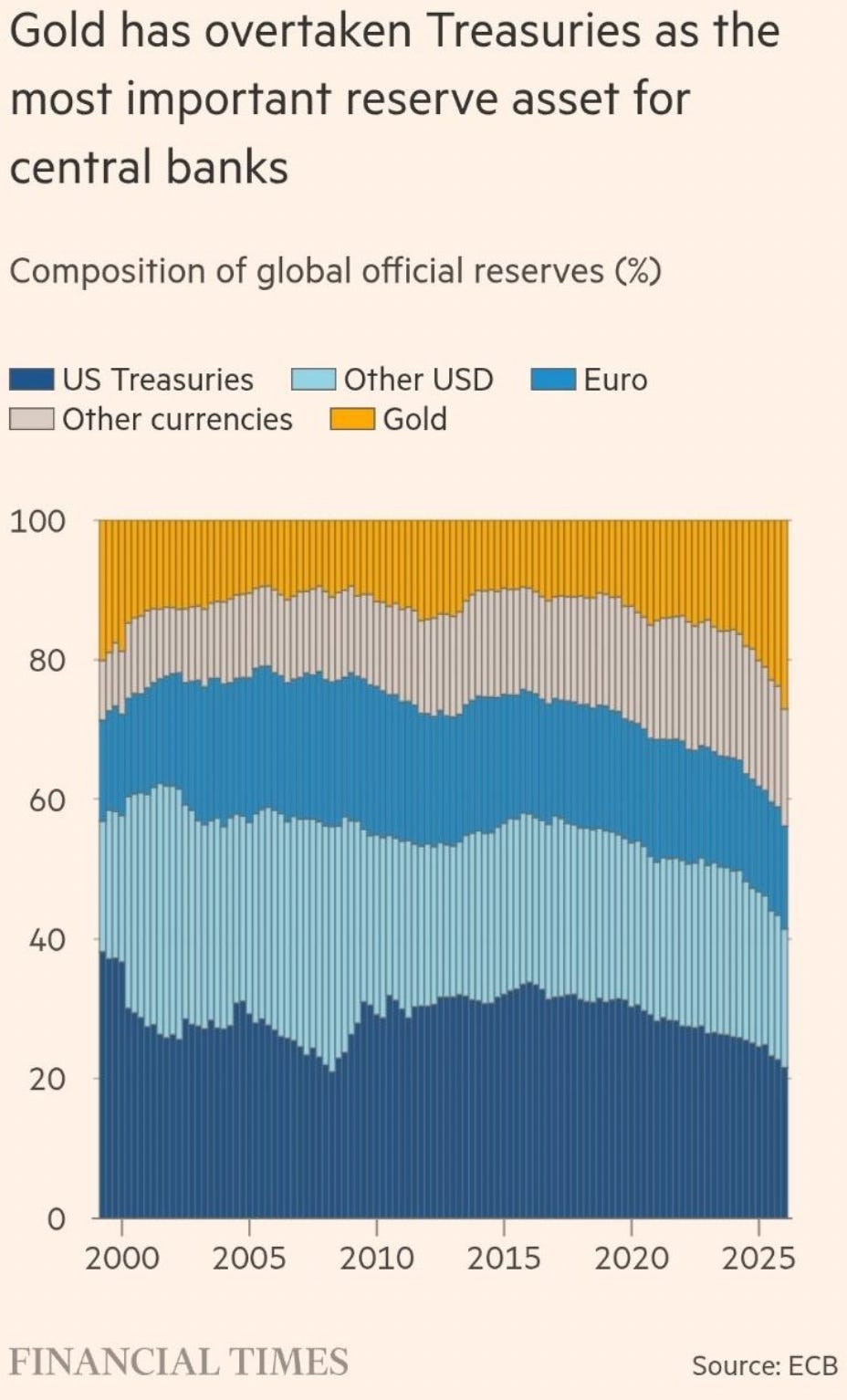
According to the ECB, gold has now surpassed U.S. Treasuries as the world’s largest reserve asset. Central banks purchased another 850 tonnes of gold over the past year as nations increasingly seek politically neutral reserve assets amid growing geopolitical fragmentation
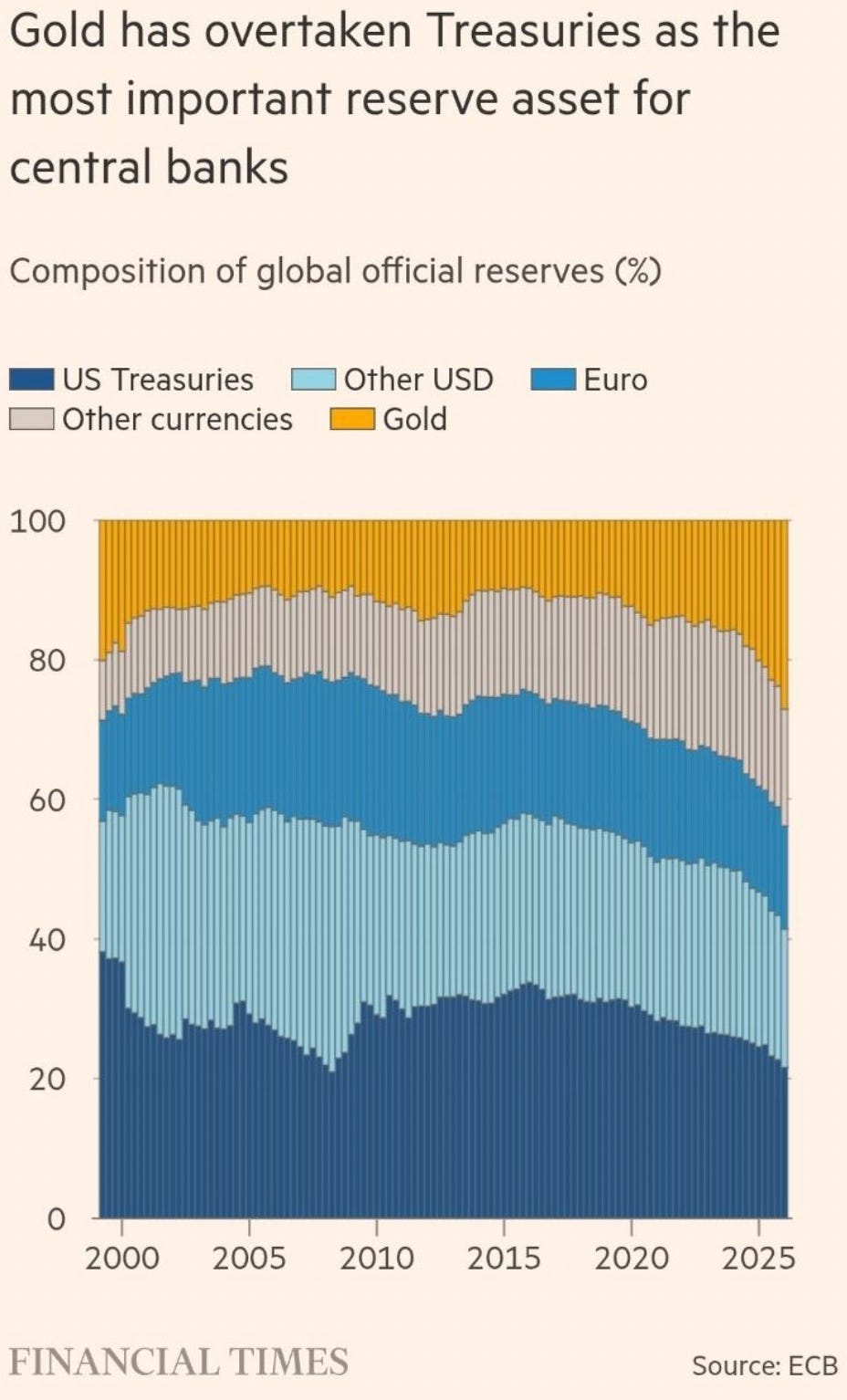
The world’s medium of exchange is still the dollar. The world’s store of value is increasingly becoming gold.
Europe is facing its own challenges.
Eurozone inflation has climbed back above 3%, its highest level since 2023, driven by both energy prices and persistent services inflation.
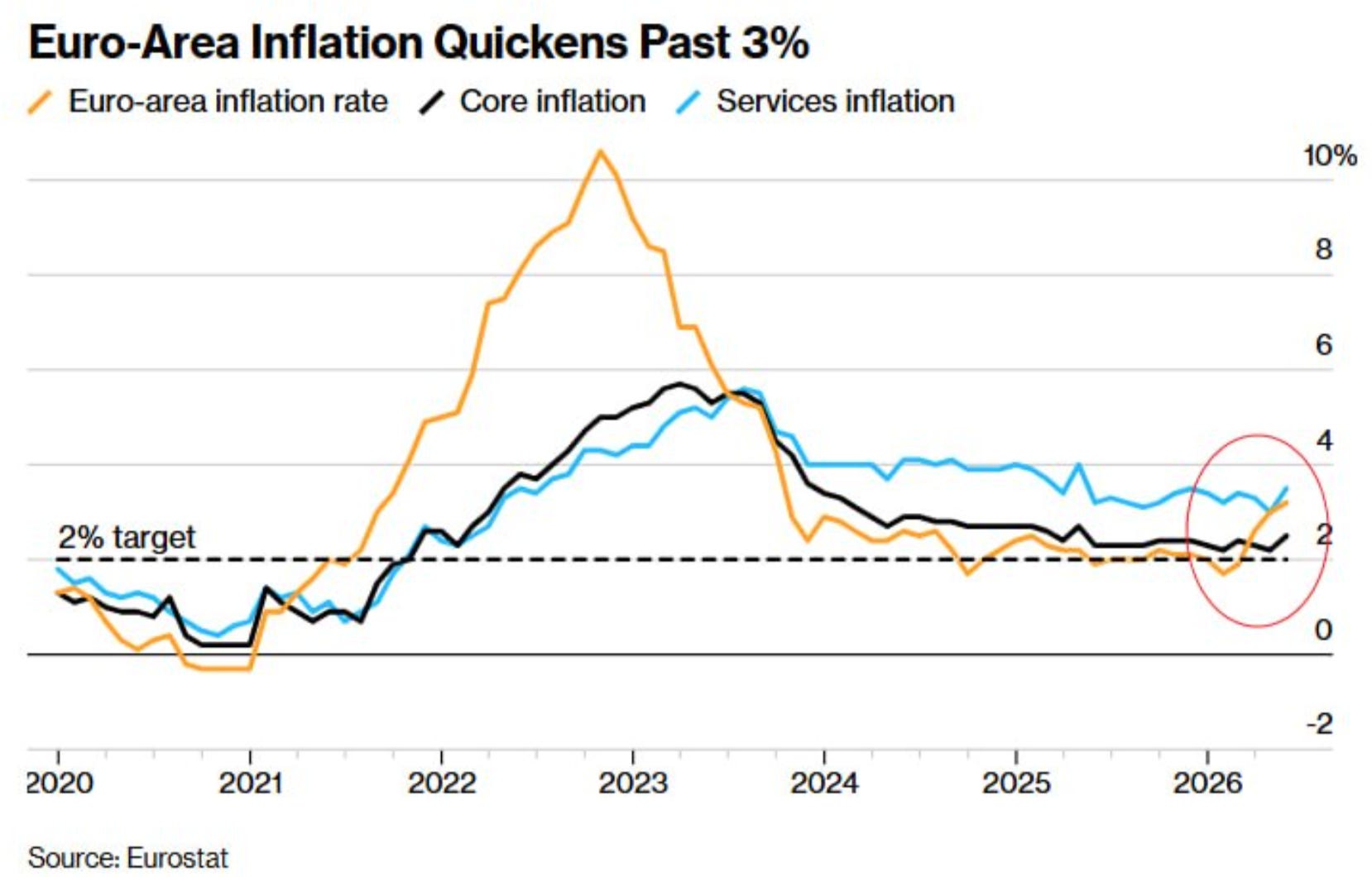
Markets are now fully pricing in another ECB rate hike next week. This could hurt families and businesses while the ECB's non-fragmentation tool and balance sheet policy continue to incentivize the public debt bubble and crowding out of the private sector
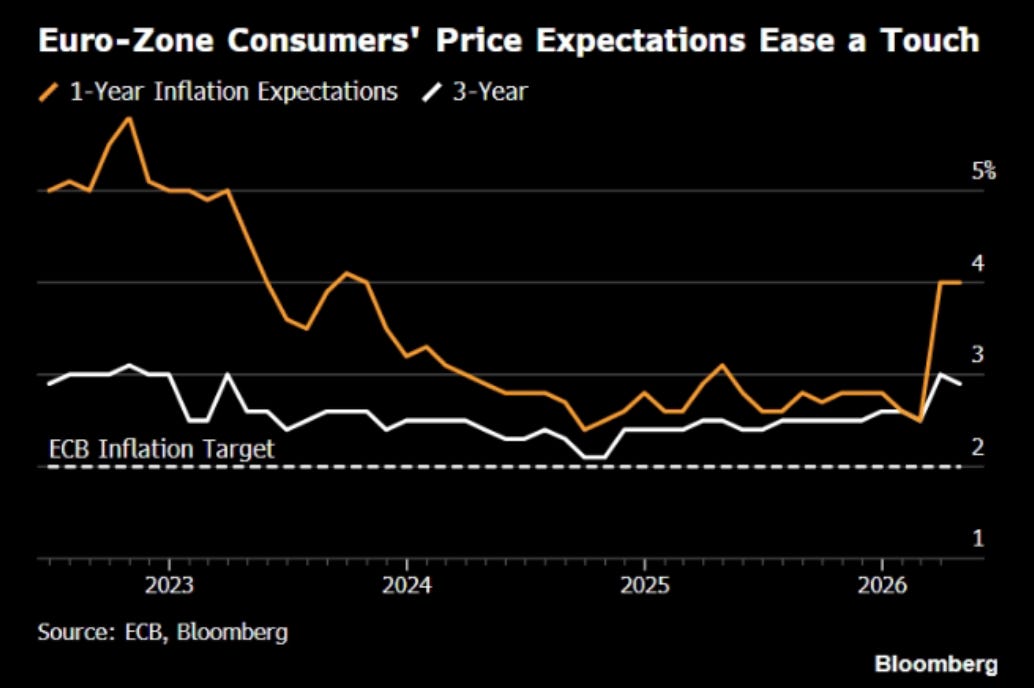
.Taken together, these developments highlight a world where central banks are once again being forced to prioritize inflation over growth, even as economic momentum remains fragile.
4. Markets Have Never Been This Expensive
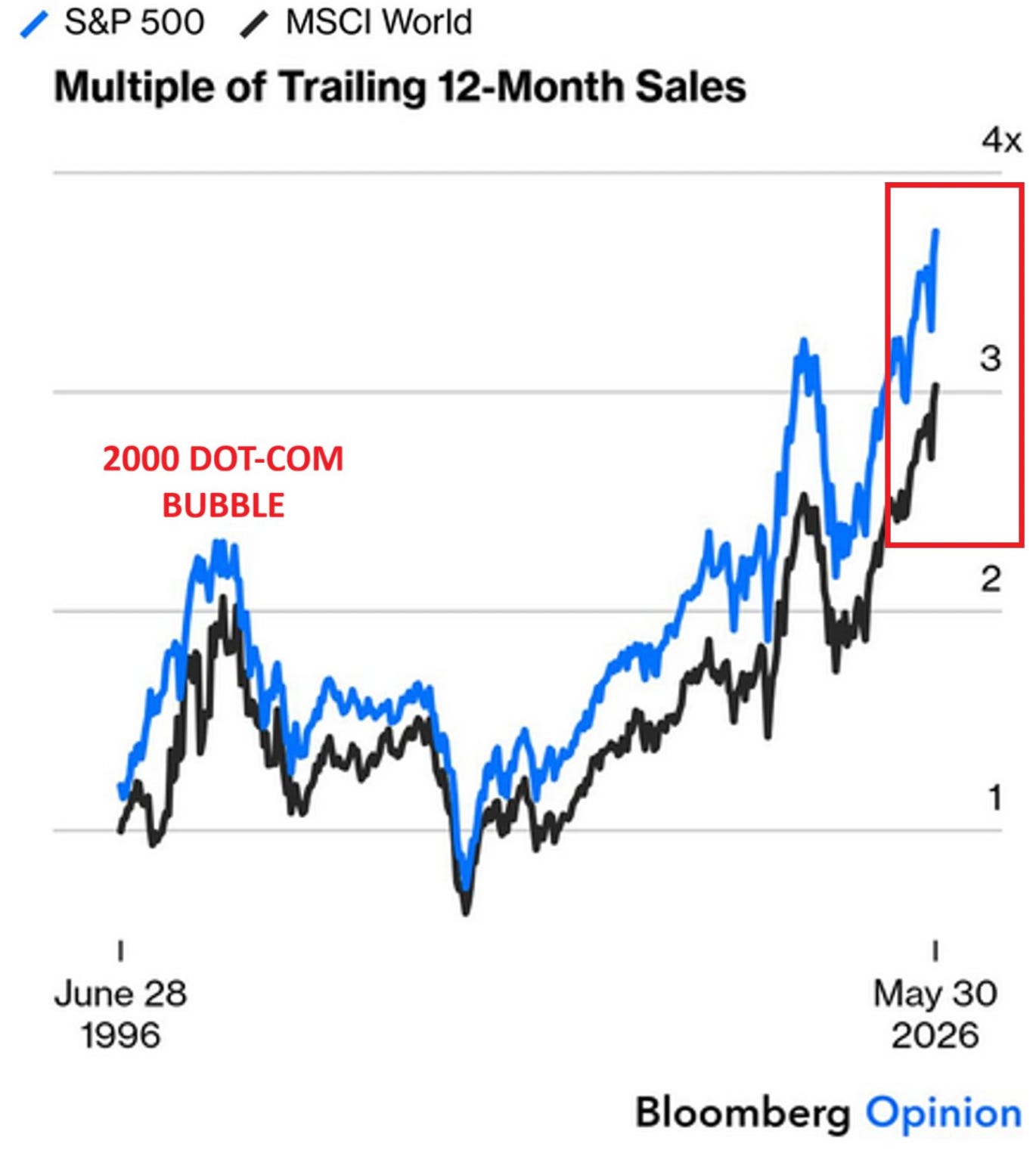
The S&P 500’s Price-to-Sales ratio has climbed to 3.7x, the highest level ever recorded and roughly 60% above the peak reached during the Dot-Com bubble. Globally, the picture looks similar, with the MSCI World Price-to-Sales ratio reaching a record 3.0x, around 50% above its 2000 peak
.
Investors are willingly paying record multiples for every dollar of sales generated by some of the world’s largest and most established businesses.
Markets aren’t just pricing growth. They’re pricing years of future success before it arrives.
At the same time, another corner of the world is experiencing its own equity boom.
South Korea’s stock market has surged to a record $5 trillion valuation, overtaking India as the world’s sixth-largest equity market. Over the last year alone, market capitalization has expanded by roughly 170%, driven largely by the AI and semiconductor trade
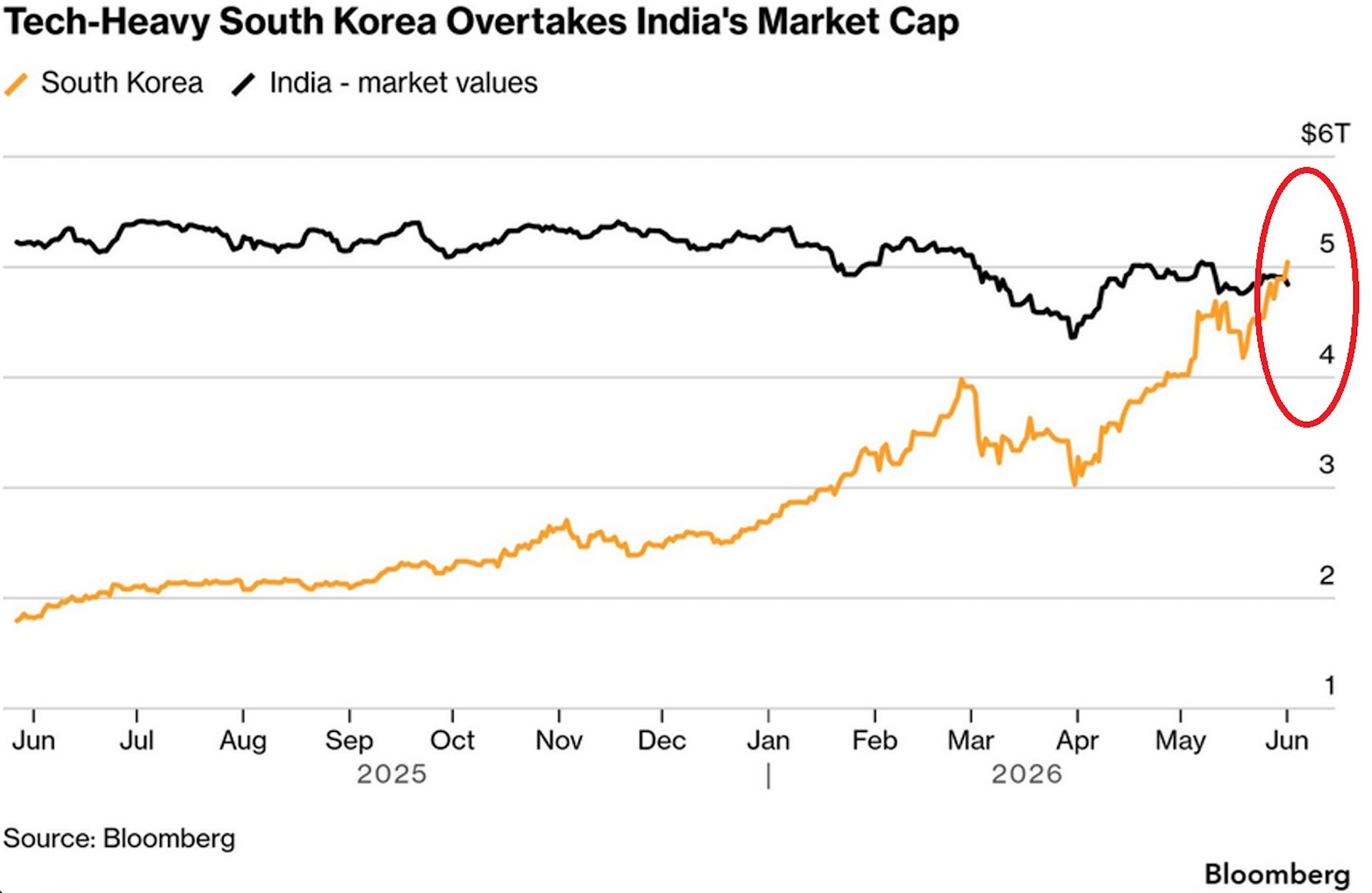
.The concentration is striking. Samsung and SK Hynix now account for more than 40% of the country’s total market value, making South Korea one of the most concentrated major equity markets globally.
The rally has been fueled by real demand for AI infrastructure and memory chips, but history suggests that when entire markets become dependent on a handful of companies, expectations matter as much as fundamentals.
The question is no longer whether AI is transformative. The question is whether today’s valuations already assume that transformation succeeds flawlessly.
4. ETF Insights And Strategy's First Sale
Over the last ten days alone, roughly $2 billion has left BTC and ETH ETFs, including a $1.4 billion outflow from Bitcoin ETFs, marking the longest redemption streak since spot ETFs launched
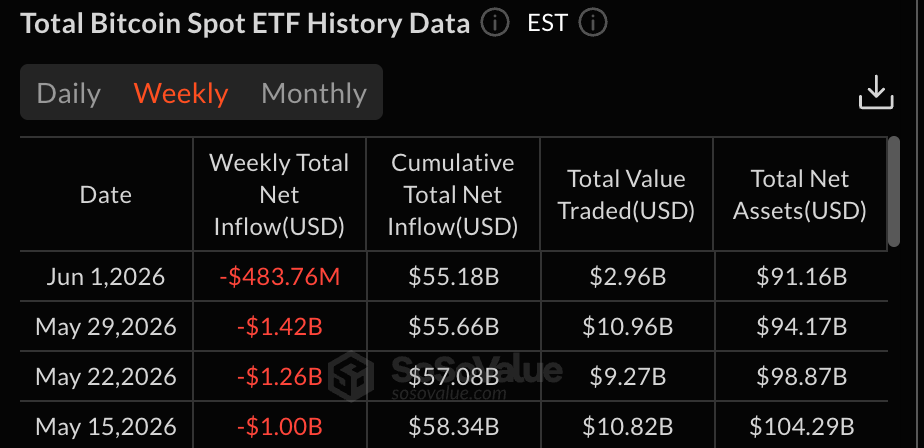
What’s interesting is that Bitcoin isn’t collapsing despite this selling pressure. That suggests long-term holders and institutional buyers are still absorbing supply in the background. But it also highlights a new reality for crypto markets: ETFs have become the marginal buyer. When flows turn positive, crypto rallies. When flows disappear, momentum quickly fades.
The April rally was driven by institutional money entering ETFs. The current weakness is largely a story of that same money stepping away. Until flows meaningfully reverse, it will be difficult for BTC to sustain a strong breakout regardless of headlines or narratives.
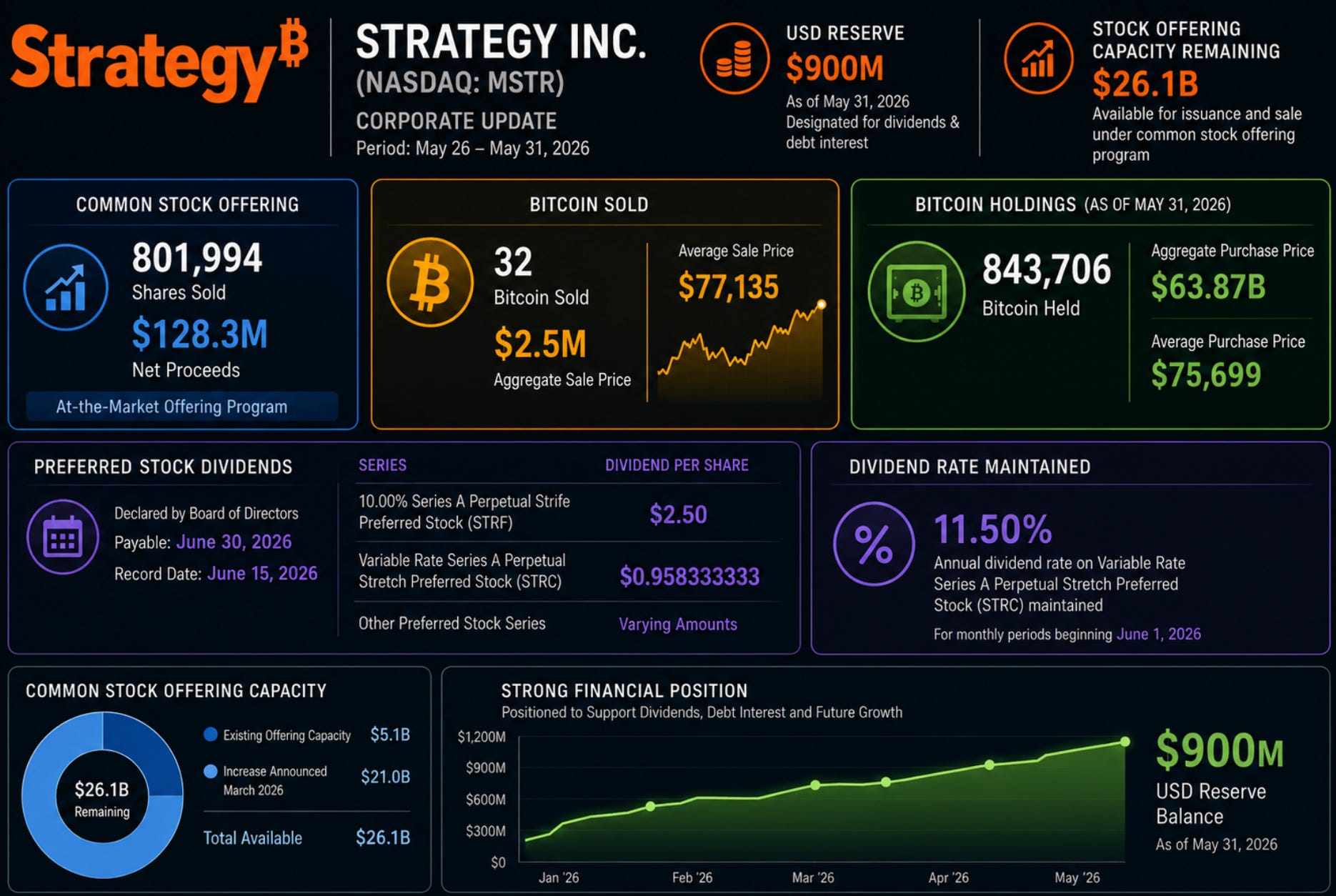
Strategy’s sale of 32 BTC worth roughly $2.5 million is insignificant relative to its 843,706 BTC treasury. The amount itself doesn’t matter. The symbolism does
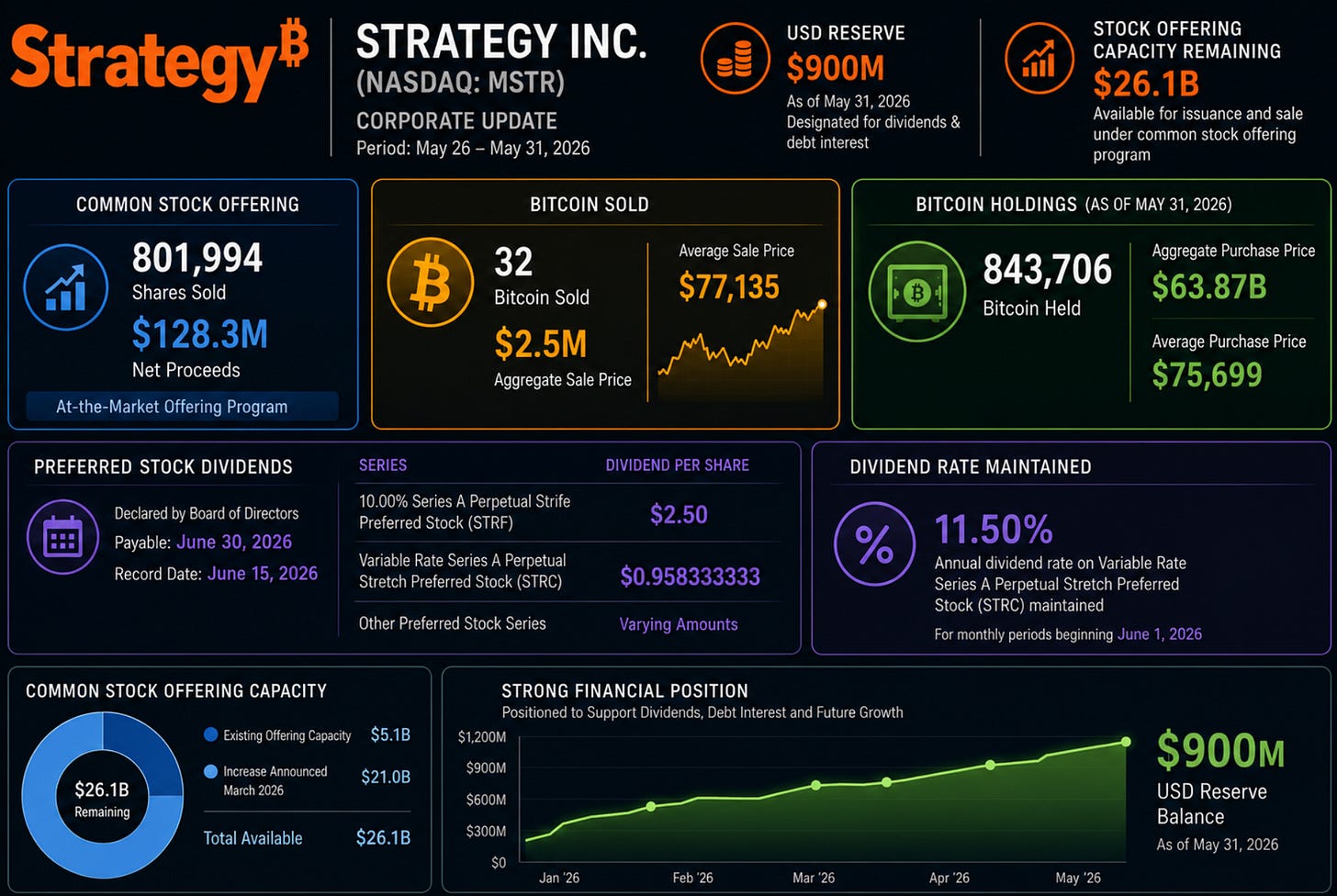
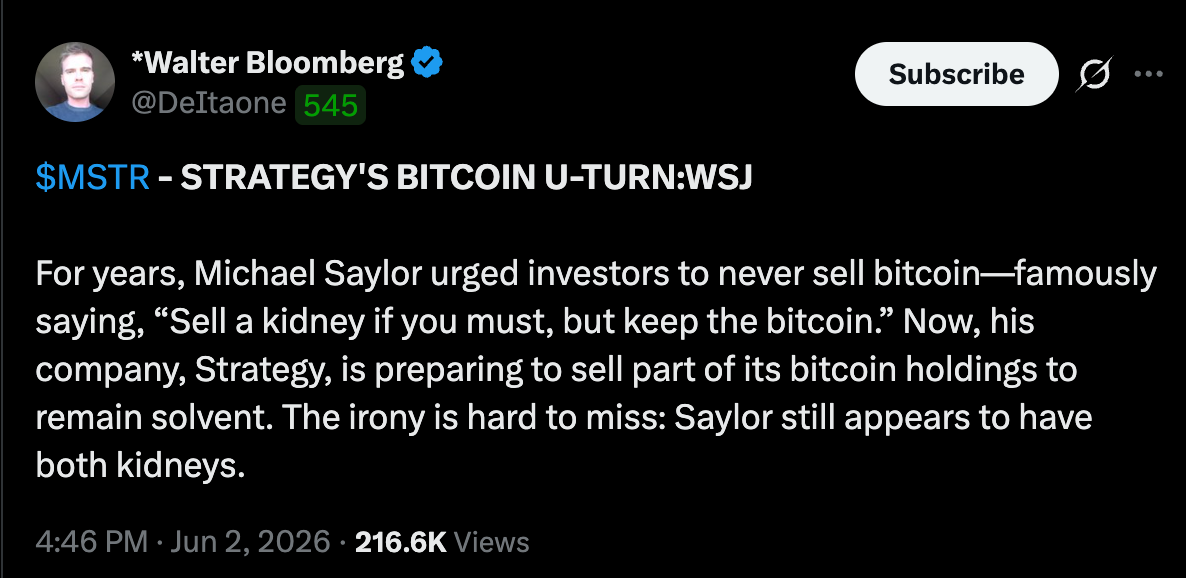
For years, Michael Saylor built a narrative around never selling Bitcoin under any circumstance. That narrative helped justify Strategy’s premium valuation and turned the company into a leveraged Bitcoin proxy. The moment even a tiny sale occurs, investors begin asking a different question: if Bitcoin can be sold to service obligations today, could more be sold tomorrow
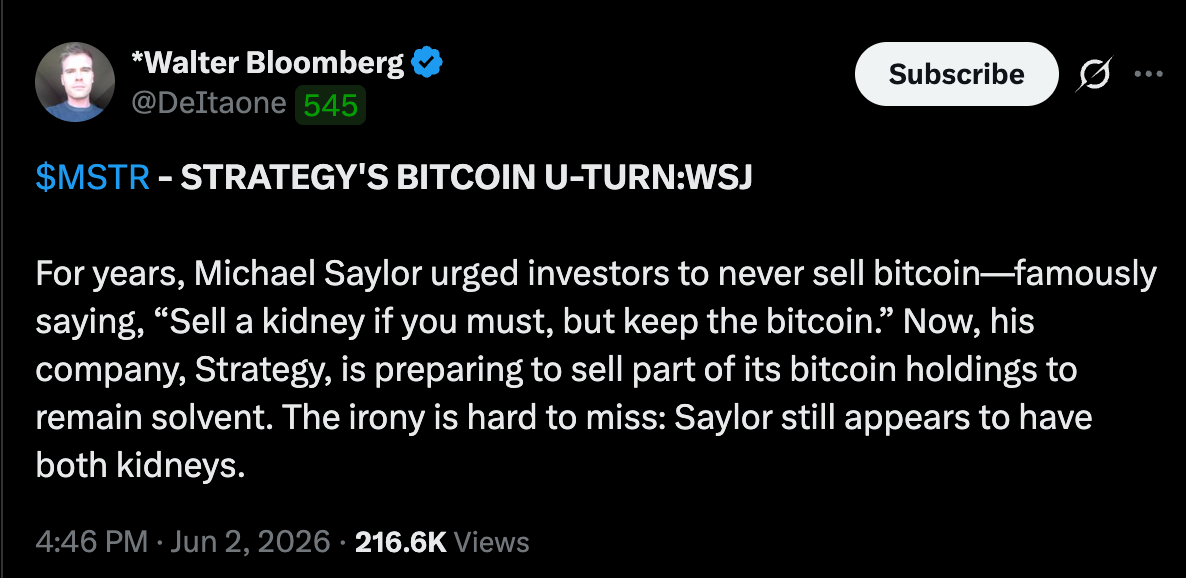
The company has raised billions through preferred securities carrying sizable dividend commitments. As long as capital markets remain open and the premium stays intact, the flywheel works. But if that premium compresses, the market may begin focusing less on Bitcoin holdings and more on the sustainability of the capital structure built around them.
5. The Week Ahead
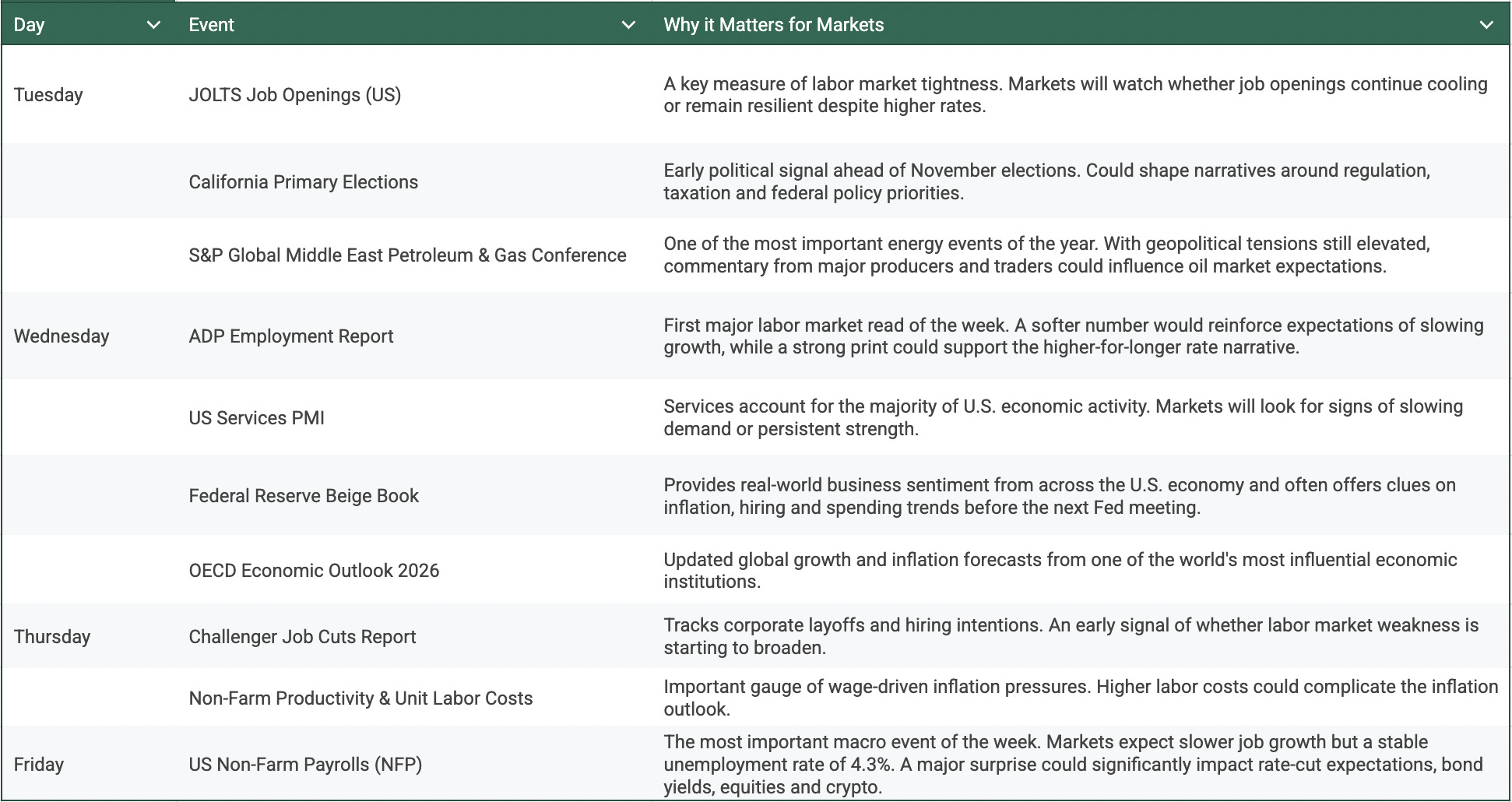
This week is all about the labor market: JOLTS, ADP, Challenger layoffs and Friday’s payrolls report will collectively determine whether the U.S. economy is genuinely slowing or simply normalizing after years of unusually strong employment growth.
If labor data remains resilient, markets may need to price higher rates for longer. If cracks begin appearing, rate-cut expectations could quickly return to the forefront.
6. Conclusion
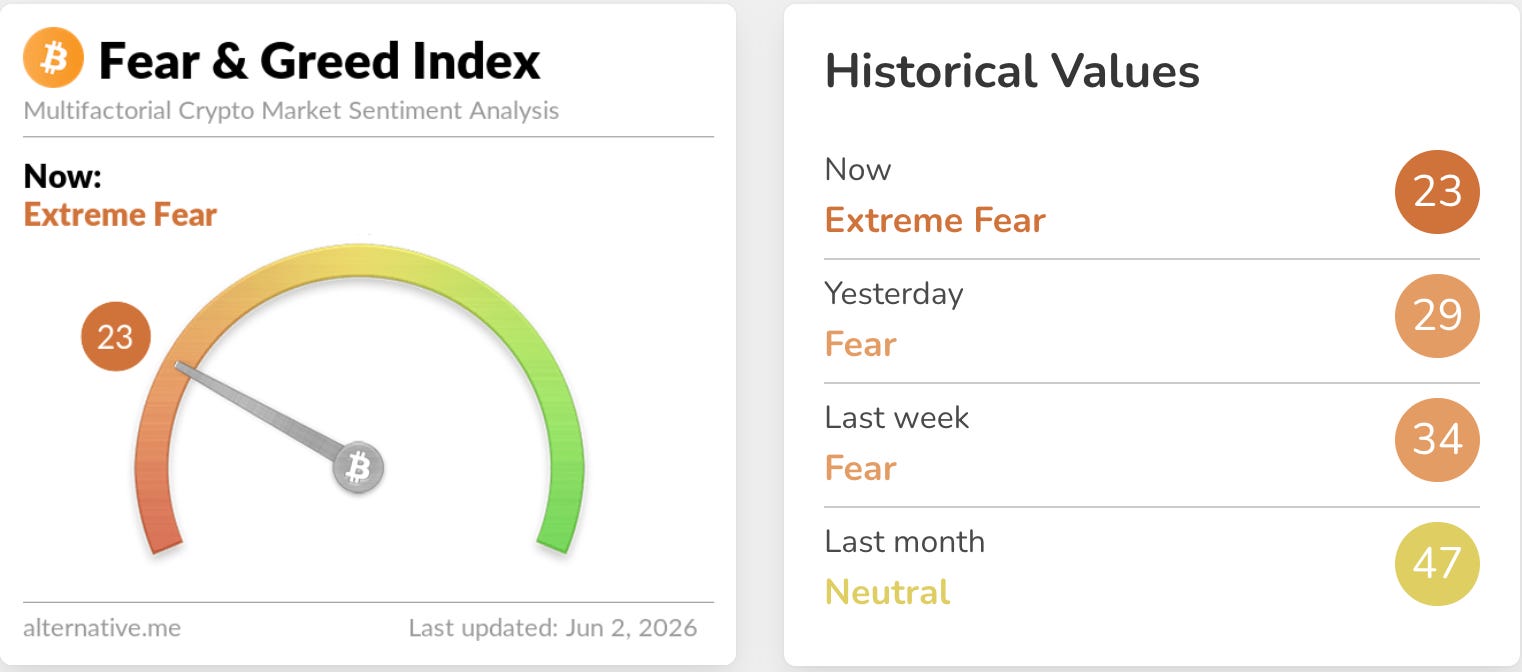
Market sentiment deteriorated significantly this week, with the Fear & Greed Index falling to 23 and slipping from the Fear zone into Extreme Fear. Throughout last week, sentiment remained in the Fear category, while conditions were relatively neutral over the past month. The sharp decline highlights a notable shift in investor confidence, pushing the market back into Extreme Fear territory.
In a market driven by liquidity swings and institutional flow, our Crush Circle platform by CryptoCrush gives investors direct access to expert research, real-time guidance, and the frameworks needed to stay ahead of the next big move.
Visit here for more information 👇